
Monday, February 7, 2011
Our Blog has officially moved!
Go to http://magillbr.edublogs.org/ for the latest information about our classroom. Sorry for the delay in blogging. I hope to kick it up a notch in the near future.

Tuesday, November 16, 2010
Purpose
Recently, we've been working on our classroom purpose. It will help us to make decisions related to learning as we progress through the school year.
I think this story I'm sharing with you today really helps us to understand purpose. It's essential to have some purpose in everything we do. If you don't have a purpose, why are you doing it? Do you have autonomy without purpose? Are you even able to gain mastery without it?
I think this story I'm sharing with you today really helps us to understand purpose. It's essential to have some purpose in everything we do. If you don't have a purpose, why are you doing it? Do you have autonomy without purpose? Are you even able to gain mastery without it?
Dipsea is a race that helps us to understand that purpose is important. Why? Well, nobody in their right mind would do it unless they have some sense of purpose to help them finish. Dipsea is a race that covers 7.4 miles. It's the oldest trail race in the US. Dipsea is not the most difficult running race in the world; however, it is treacherous and very challenging. Many racers have become injured while racing on the course which starts at sea level and rises to 1360 feet and descends back to sea level. Different points along the course have telling names like Cardiac, Insult Hill and Dynamite.
At this point, ask yourself "Would you enter this race? Why? Why not?
Read the story about Dipsea from Runners World Magazine. Next, read and listen to the 2010 race recap with Reilly Johnson.
What does this make you think about purpose? How does this relate to our classroom purpose?
At this point, ask yourself "Would you enter this race? Why? Why not?
Read the story about Dipsea from Runners World Magazine. Next, read and listen to the 2010 race recap with Reilly Johnson.
What does this make you think about purpose? How does this relate to our classroom purpose?
Friday, November 5, 2010
Mastery
Here's the last video for the day.
What questions come to mind as you watch the video related to mastery thinking?
What questions come to mind related to high quality?
What questions come to mind as you watch the video related to mastery thinking?
What questions come to mind related to high quality?
Cooperation & Mastery
This video explores what can happen when we all work together to learn and improve to a high degree. Ask yourself these questions:
What in the video is evidence of high levels of cooperation?
What in the video is evidence of mastery?
Ok Go - Here It Goes Again
What in the video is evidence of high levels of cooperation?
What in the video is evidence of mastery?
Ok Go - Here It Goes Again
Monday, November 1, 2010
Farmer John

Recently my friend, Farmer John, called me. We were talking about his farm and he explained to me that his irrigation system for his farm was recently shutdown due to a problem with the freshwater source. Farmer John explained that he would not be able to use the stream water he had been relying on due to low water volumes from the dry summer. He said he could only take some water from the stream as other wildlife like salmon depended on it to swim to their spawning grounds. Farmer John said the state is only allowing him to capture a small amount of water. He's worried about the crops he's planted. However, I told him why not use some of the saltwater from the ocean nearby. I said, "You could mix it with the freshwater you're allowed to harvest and conserve your freshwater and grow your crops!" I told him we've been experimenting with different levels of salinity. We could study the problem and share our findings. I said, "We'll find the range of tolerance for the crops." He said, "That would be great!"
Well, you guys have heard the story. Now, we need to think about the experimental design. Let's review what we did yesterday.
First, what predictions do you have for the seeds in the different cups? Remember we have cups with 0, 1, 2 and 4 scoops of salt per 1000 ml of water for irrigation.
Yamilet: "I think that the one with zero will have more growth than the cups with 2 and 4 scoops of salt."
Elizabeth: "She took mine."
Chris: "The cup with zero scoops of salt will grow."
Haylee: "I think that 1 and 0 will grow, but 2 and 4 will not because there's too much salt."
Estefani: "The cups that have 2 and 4 they have too much salt. I don't know if some plants have salt."
The Mono Lake Story
Take some time to view the video. It reviews the story of Mono Lake and may help you to improve connections with the study we did with brine shrimp for Dr. Flint Jackson in aquatic environments with salt.
Tuesday, October 19, 2010
Brine Shrimp Investigation 1
Check out the brine shrimp in the video below.
What are your predictions for the last question?
Fama: "If you put 2-4 scoops of salt in the cup with zero scoops, the brine shrimp will hatch. If you put water in the cup with 6 scoops some might hatch."
Riley: "The cup with zero scoops, if you put 2 scoops of salt, it would be just as good as the other cup with 2 scoops. More would be hatching."
Khanetria: "The cups with 6 scoops, if you put more water in it, some of the salt will evaporate and more brine shrimp will hatch."
Estefanie: "If you make the changes in the video, the brine shrimp will hatch."
Wednesday, October 13, 2010
Gas Prices
What does this picture have to do with Unit 1?
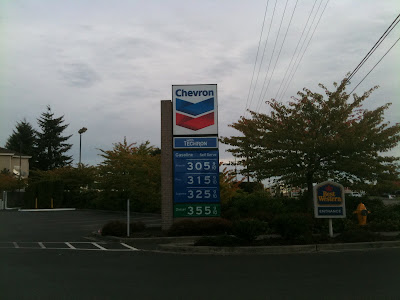
What question(s) come to mind when looking at the 4 prices?
Monday, October 11, 2010
The Optimum Level of Cooperation
Check out this video.
What questions come to mind?
Jesse: "How did they do that?"
David: "When did they rehearse?"
Elizabeth: "How did they not get confused?"
Haylee: "How long did it take them to do it?"
Kamren: "What year did this take place?"
Ilisabeth: "How did they make patterns?"
Harmandeep: "Who first came up with the idea?"
Riley: "How did they pass each other without crashing?"
Fama: "How did they do that with confidence?"
What would happen if 1 motorcyclist turned the opposite direction of the flow?
Monday, September 27, 2010
Letter from Dr. Flint Jackson
9/25/10
Dear Mr. Magill,
As I told you in our conversation on the telephone, I've been studying the bird populations around Mono Lake. This is a lake in Northern California. The lake has been drying up and getting smaller. As a result, Mono Lake has become a salt lake. As the level of the lake falls, the concentration of salt, or salinity has increased. This environmental change might be affecting the organisms in the area. For instance, the lake has small organisms called brine shrimp. The birds that migrate to the lake depend on them. If the lake continues to get saltier, either because the lake is drying up or fresh water flowing into the lake is being reduced, the salty aquatic environment might have an effect on the shrimp.

I would be most grateful if your class chose to help me out on a research study. I'm trying to figure out if the salinity is an environmental factor that's affecting the hatching of Mono Lake brine shrimp eggs. If so, I've sent you some brine shrimp eggs from Mono Lake to use for research.
Would your class be able to help to design an experiment that would contribute to my studies?
Sincerely,
Dear Mr. Magill,
As I told you in our conversation on the telephone, I've been studying the bird populations around Mono Lake. This is a lake in Northern California. The lake has been drying up and getting smaller. As a result, Mono Lake has become a salt lake. As the level of the lake falls, the concentration of salt, or salinity has increased. This environmental change might be affecting the organisms in the area. For instance, the lake has small organisms called brine shrimp. The birds that migrate to the lake depend on them. If the lake continues to get saltier, either because the lake is drying up or fresh water flowing into the lake is being reduced, the salty aquatic environment might have an effect on the shrimp.

I would be most grateful if your class chose to help me out on a research study. I'm trying to figure out if the salinity is an environmental factor that's affecting the hatching of Mono Lake brine shrimp eggs. If so, I've sent you some brine shrimp eggs from Mono Lake to use for research.
Would your class be able to help to design an experiment that would contribute to my studies?
Sincerely,
Dr. Flint Jackson
Tuesday, September 21, 2010
Place Value
Today we each tried to come up with a way to describe place value. I used the metaphor of stadium seats (Note: Mr. Rodger's idea.). Many of you know your position in a stadium determines the value of your seat. If you could choose 2 seats at Safeco Field for a game, based on the picture below, what would you choose? Now think about that and pick 2 seats with a higher value. Last, pick 2 seats that would have a value less than the starting tickets. How does the position affect the value?

Now let's think about that in terms of a number. Which number below has the greatest value? Which has the smallest? How does the position of the digit affect the value of the number? Now, describe place value to another person.
222,222
Friday, September 17, 2010
"Goodnight Elodea."
We found the other day that organisms, like goldfish, give off carbon dioxide. In an aquatic environment the carbon dioxide can mix with the water and result in carbonic acid. This is bad for the fish. We were unsure if plants gave off much carbon dioxide. We wondered if they react differently at night. Our tests were all done in a daytime environment. So, I placed some elodea in my closet for the weekend. If the plant gives off a lot of carbon dioxide it will change the blue water to yellow. What do you think will happen? Let me know what you think and leave a comment.
Haylee lets off some hot air.
Today we discovered that when carbon dioxide mixes with water it creates carbonic acid. Check out the video demo with our BTB indicator. The blue water will change to yellow as carbon dioxide reacts with it to create carbonic acid. We finally got to the bottom of why our fish were dying. After a few investigations we concluded that the fish were poisoning themselves. They create carbon dioxide as water is pumped through their gills. Yikes! Our aquariums needed a quick water change. Hopefully this helped. We'll see on Monday. Keep your fingers crossed.
Thursday, September 16, 2010
Where did the acid in the tanks come from?
Today we got our first taste of the Scientific Process. 
What was the question that motivated us to conduct a controlled experiment?

- Our class looked at using an indicator to get more information about something we're studying. In our case, we're studying aquatic environments. We used BTB to determine if acid was present in the aquariums we were observing.
- This forced us to think about the variables that may have caused the acid to occur. We considered the fish food, water source, algae, bacteria, fish waste, fish and plants.
- Then, I challenged you to consider which of these variables could have caused the acid. We narrowed it down to plants and fish. These could be called organisms.
- So, each group conducted a controlled experiment. Everything was the same, or controlled, except for the type of organism in the water. The organism was the manipulated, or changed, variable.
The results are indicated in the photo. Remember that when the BTB remains blue, there's no acid. When it begins to turn green-to-yellow there's more acid in the container.
Science Journal Entry
-Take some time in your journal to write the question down and to answer it in your journal. Don't forget to number and date the page.
Which organism created the most acid? How do you think this organism created the acid in the water?
What was the question that motivated us to conduct a controlled experiment?
Just do it!
This morning students came to a consensus on where they stand in terms of a fitness issue. The Consensogram tool, by David Langford, was used to help measure their interest. Kids vote in 10 % intervals on a scale that goes from arange of 0-100%. They vote according to how they feel about a statement that I present. First, I asked kids how fitness might impact them as ind
ividuals. Elizabeth said, "It would give us more energy." Together we agreed that we'd be much healthier. Also, we made connections that it may help us to perform better in events like Cheetah Club, 5th Grade Olympics and even classroom activities. Below is a picture of the results of how much students agreed with the statement,

"To what extent would you be interested in starting a fitness routine as part of our regular classroom schedule?"
Tomorrow we will begin to brainstorm what we'd like to work to improve in terms of our fitness. Stay tuned.
Wednesday, September 15, 2010
Hired!
Recently we finished our jobs board. The class took the information they came up with and created an organized list of jobs and specific roles. The kids jumped right in and started to help out. I'm really excited to see the kids come together to make a community that works so well, and they are responsible for designing it. Good work Room 35! Here are some pictures of the finished products.


Monday, September 13, 2010
Aquariums!!!
Science Reflection
We started work in our Science Journals by making observations. We discussed the difference between "fact and opinion." Below is an example that I created. I used a diagram to create more meaning for the parts of the environmental system. We learned that these are called environmental factors. Some examples we listed are the tank container, water, temperature of water, goldfish, etc...

Take some time now to watch the short video I took in class yesterday to respond in your Reflection Journal. Don't forget to update your Table of Contents, page # and date. This will give you time to remap your thinking and to make your connections stronger. ZZZZZ! Get the electricity flowing. Get smarter now!
Thursday, September 9, 2010
Jobs!

Today we started to look at jobs for the classroom. I explained that our classroom might work more efficiently if we all did some things to make the day go smoother. The kids pitched in and started to come up with ideas to help out. Stay tuned for more pics that show how their ideas develop and become more focused. We'll use an affinity exercise to guide our work. Ask your child about it.

We continued working on the Jobs project today (9/10/10). Students worked hard to place jobs into categories. Stay tuned as the work continues to evolve.
Thursday, September 2, 2010
Code of Cooperation

We did it. Today we turned a corner on our classroom culture. Our Code of Cooperation will guide us in a direction that will help us to maximize learning time. Good work folks.
Wednesday, September 1, 2010
2010-2011 First Day!
Wow! I'm really excited about the work we accomplished the first day of school. Our class really worked hard to develop some ideas that hold a special significance for this part of the school year. They will all help us to maximize our learning time. Here's a list of some of the items we covered on our schedule.
-"Good Morning" and how it relates to a special concept that we'll call High Quality.
-Ready to start?
-On Time Performance
-Ready to go?
-What does it mean to be organized?
We didn't have time to reflect today; so, if you get a chance, create some time to share the blog with your parents at home. Explain one or more of the above activities. I want this blog to be another resource you can access to improve your learning. If you'd like, be sure to make comments that will contribute positively to the site.
Subscribe to:
Posts (Atom)